Latest Posts

Springtime in Albuquerque

Francis, my cockapoo who never leaves my side, is curled up on a pillow next to me. Francis prefers to sleep in, but he is a creature of routine. We get out of bed and go down to the kitchen for a cup of French roast coffee.

He has his first trip outside into the morning air. I watch him. We have hungry coyotes in the neighborhood. They can jump high fences and snap the neck of a little dog in moments. Francis doesn’t linger. He has no fear.  He just longs for  the comfort of his pillow. Life is good.

This is a good time of year in Albuquerque. Blue sky. Sunny. Dry mountain air.  Chilly last night as we slipped into the thirties. The temperature moves slowly back up to the seventies by afternoon. Soon it will be hot again. Too hot to go outside. Now is a perfect time.

After total neglect last year, both my thymes, English and Lemon, are happily growing. My French tarragon is amazing. It loves our weather. My big surprise was the clematis I had growing in a pot with a trellis next to the patio door.  I bought it about four years ago at Costco. It has four-inch, deep blue flowers when in bloom.  It looks better than ever. It is always a joy in the spring to see plants wake up and start their growing season.

Today is Wednesday. It is the day I give myself an injection of Orencia, abatacept. It is a drug with a low list of complications. No cancers or bowel perforation. Infection is the big one. This time, I have been taking it since last August, eight months. It was working about fifty percent for me. The rest has been a struggle. I feel like it is slipping. Not fifty percent anymore. More like twenty to thirty.

There is not much left in my RA doc’s arsenal.  I have tried many of the other biologics and they didn’t work.  Or they cause cancer like the JAK inhibitors or bowel perforation like Actemra. I am at risk for these complications.  I have had too many complications from other drugs  in the past to brush off the warnings. 

She brought up Imuran last time we talked. It is a drug also used to suppress the immune system for organ transplants. It takes up to twelve weeks to start working.  It is a scary sounding drug. But as my RA cycles back into severe pain, I will, like most people, try anything, almost anything.

Do You have rheumatoid arthritis?

Most patient literature fails to distinguish between early symptoms, later developments, and complications. The following are common early rheumatoid arthritis symptoms.

Pain

Pain is a hallmark of rheumatoid arthritis.

The pain comes in many forms in the same person.

  • It is sharp as the edge of broken glass. It is burning. It can be a dull ache. It is incapacitating and it can be unrelenting. Pain is more noticeable on movement. Sometimes it is excruciating. The proximal joints of the fingers, the knuckles, wrists, the toes, and joints in the feet are affected. The shoulders, elbows, knees, and ankles become affected. The cervical spine is frequently affected. The temporomandibular(jaw) joints can be affected.
  • Pain may increase as the day wears on. Trouble is the pain is not in one spot. It usually encompasses many joints, and the pain feels global. Sometimes overwhelming.
  • Some RA pain comes from the pressure inflammatory swelling exerts within a joint.
  • Pain also comes from irritated nerves that have been affected by the proteins and chemicals that are released by the inflammatory cells.
  • Pain can come from the ligaments and tendons affected by the joint inflammation.
  • Pain can come from bony erosions.
  • And so it goes. Our RA is a different combination than anyone else. And in our own body, RA will surprise us and change.  

Fatigue

RA fatigue is unlike the fatigue associated with being tired. This fatigue is not relieved by rest. RA fatigue is immobilizing. It is overwhelming. It is as a result of RA inflammation in the body.  Cytokines, chemicals produced by the inflammation process, are a major factor in this profound fatigue. As inflammation is reduced, the overwhelming fatigue may also be reduced. RA’s general feeling of being unwell, without energy is both biologic and genetic in origin.

Morning stiffness

The bilateral stiffness seen in active RA is most often worst in the morning. It may last one to two hours (or even the whole day). Stiffness for a long time in the morning is a clue that you may have RA since few other arthritic diseases behave this way. Stiffness may also occur after sitting or being inactive for an extended length of time. This is called gelling.

Swelling

Inflammation in the joints may cause swelling to spill over into the surrounding tissue. Swelling is going to stretch against the joint capsule and against the skin. The pressure of the swelling will cause pain. Swelling may be more noticeable in the hands and the feet, but it can occur in any joint affected by RA. My feet and toes are always swollen.

Systemic polyarthritis

The hallmark feature of RA is persistent symmetric polyarthritis that affects the hands and the feet. Although one joint or multiple joints may initially be involved. Joint involvement eventually becomes symmetrical. For example, the right wrist may be inflamed and in pain. The left wrist joins in and hurts, too

Symptoms that last six weeks

Joint pain, tenderness, swelling, and stiffness continues for six weeks or longer in order to be given a diagnosis of RA.

Small Joints

 Joint inflammation frequently begins in the small joints of the hands and feet.  More than one joint is affected. The middle joints of your fingers, the joints that attach your fingers to your hands. Your wrists.   Your toes. The joints that attach your toes to your feet. Your ankles.

RA may start out or occur later in the following joints:  Knees, shoulders, elbows, hips, cervical spine, and the jaw. The little bones in the ear may also be affected. Every moveable joint in the body can be affected by RA. My shoulders were initially involved too.

Low grade temperature

A temperature between 99° (37.22°) and 100.5 F (38°C) is characteristic of inflammation.  A temperature over 100.5 F (38°C) is characteristic of infection. A low-grade temperature is common. when the joints are inflamed.

Loss of appetite

Some have no appetite because the process of inflammation is so pervasive that their bodies lack the energy to process food. Nausea is common both due to the inflammation process and due to the drugs used to treat RA.

Your early symptoms will be your own. My onset was severe. Both my hands and feet were swollen. The pain in my shoulders was sharp and excruciating. I felt exceedingly fatigued. I lost my appetite. Mornings were tough. I ended up in the ER. The doc gave me a steroid in my IV. For the first time in months, I felt like a new person.

A test for RA

2010 ACR-EULAR Classification Criteria

This test is commonly used by rheumatologists to help determine a rheumatoid arthritis diagnosis for new patients. This test is used on patients with at least one inflamed joint that has no other explanation for its cause.

Choose one value for each category (A-D); Add the score.                                A score of ≥ 6/10 is needed for classification of a patient as having definite RA.


A.Joint InvolvementValueScore
One large joint0
2-10 large joints1
1-3 small joints, with or without involvement of large joints2
4-10 small joints, with or without involvement of large joints3
>10 joints, at least one small joint5
     
B.Serology, at least one test result needed for classification
Negative RF and negative ACPA (Blood Test)0
Low positive RF or low positive ACPA (Blood Test)2
High positive or high positive ACPA (Blood Test)3
C.Acute-phase reactants, at least one test result needed for classification
Normal CRP and normal ESR (Blood Test)0
Abnormal CRP or ESR (blood test)1
D.Duration of Symptoms
<6 weeks0
>6 weeks1

Test yourself. My score was 7. I am seronegative RA. I had over 10 joints involved initially. My C-Reactive protein and my ESR were off the charts, and I had symptoms over six weeks.

Being Bald

In the summer of 2018 I went from a full head of salt and pepper hair to a completely bald head. I was having chemo for a rare and aggressive uterine cancer. I had discussed my pending hair loss with my hair stylist. She gave me a pixie hair cut and would do more depending on the progression.

My oncologist, a remarkable woman, could tell me little except that I would lose my hair. So, I found an online discussion group. English, actually. Health Unlocked. They had what I needed.

My hair loss was sudden, rapid and painful. My hair follicles were inflamed. My pain was horrific.  And then, as suddenly, it was gone. I became totally bald, no hair on my head, no eyebrows, no eye lashes, no hair anywhere.

The effect of chemo is like that of radiation, cumulative. I was fine at first. Then I lost my energy. There was no nausea or vomiting. During the infusion I was given a cocktail of medications to keep the side effects at bay. They worked. I plodded. I got through it. My son drove. He cooked. He was my support.

Chemo started six weeks after major gutting surgery. By the end of chemo I had very little left. When we went out,  I wore a head covering. At home I didn’t. I was about to give up the head covering all together but I didn’t.

This issue with Jada Pickett-Smith stirred up difficult memories. Many of the commentaries seem to forget that she has an autoimmune disease that is very difficult. The situation was a woman with a disease being the butt of a joke. She wasn’t in a nightclub. She was at an awards show.

My hair loss lasted a long time. It didn’t start growing in until the next year. I was weak. I was scared. Would my hair come back? What would I get? I would have been crushed if someone had ridiculed me.

ASA

The drugstore pain relievers

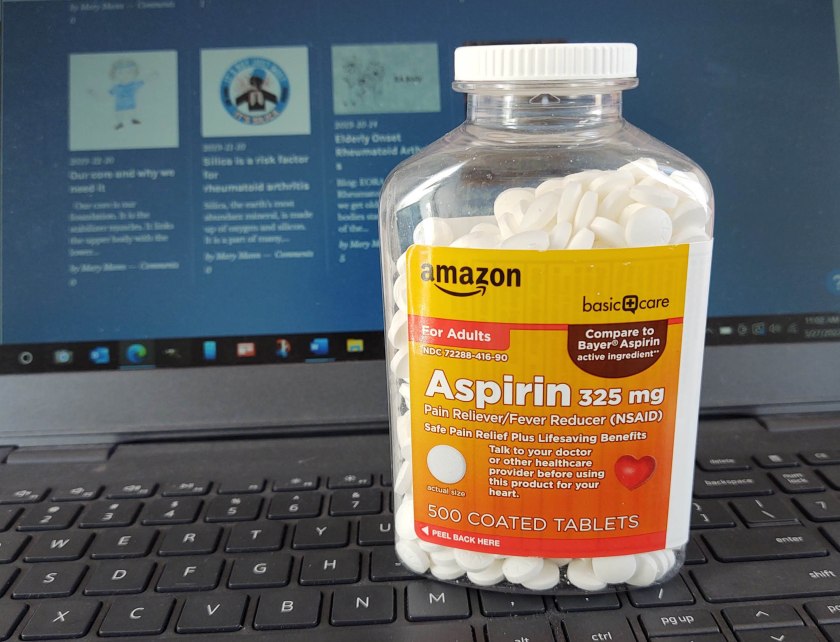
Aspirin

ASA

As the best pain reliever in the world for the better part of  a century, aspirin was the medication everyone turned to for headaches, fevers, joint pain and anything else that needed to be relieved. It was the only pill in town. My dad has his bottle of the white pills on his nightstand.

Aspirin  was the first  manmade concoction marketed to relieve arthritic pain. It was the Bayer company in Germany in 1899 who refined and stabilized the pain-relieving salicylate, acetylsalicylic acid, ASA,  and then sold the powder to physicians. It was formed into  a pill and marketed it as aspirin in 1915.  Aspirin is a powerful drug that helps to bring down fevers,  relieve arthritis pain, menstrual cramps,  headaches plus many other maladies.

To good to be true?  Maybe. Maybe not. Aspirin is a good pain reliever. However, to relieve the pain of RA a dose that is too large would be needed. And with large doses of aspirin there is a risk of GI bleeding which can be dangerous. There is also a risk of thinning blood so that bleeding becomes a problem.  For children aspirin can cause Reyes Syndrome. And there are some who have allergies to salicylates.

Aspirin is a good medication in recommended doses over recommended times for adults who have no allergies to salicylates.

Acetaminophen (paracetamol) 

acetaminophen

Mixed with other drugs, acetaminophen had been around for a while. In 1955 Children’s Tylenol was launched.  For the first time, acetaminophen was manufactured as the only active ingredient. It took six more years  for regular strength Tylenol to be launched in 1961 for adults.

 Aspirin now had competition. And now people had another choice. Acetaminophen became  the next drug store pain reliever. Tylenol had arrived.

Of the four drugs, acetaminophen is the only one that is not a NSAID. It doesn’t have noticeable anti-inflammatory properties. Used excessively it can cause liver and kidney damage.

Here again in recommended doses for recommended times acetaminophen is a safe pain reliever for most adults.

Ibuprofen

Ibuprofen

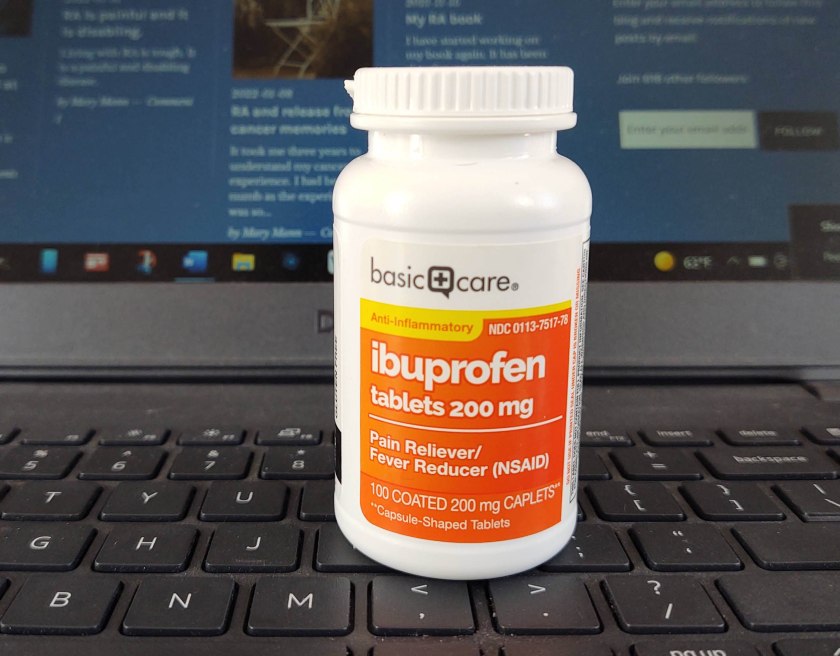
The Boots Company developed Ibuprofen in 1969 in England. Initially, the NSAID, was a  prescription drug in the US. It became available as an Over-the-Counter (OTC) drug in 1984.

So now we have three drug store pain relievers.

Aspirin now has lots of competition.

And

we have more choices when we go looking for

pain relief.

 Ibuprofen is meant to be used short term. But like many other drugs, it is used excessively. Ibuprofen will cause stomach bleeding especially in those over sixty.  Ibuprofen can also cause stroke or heart attack. The odds increase with the length of time and the amount of ibuprofen used.

Diclofenac, a NSAID, was first marketed in 1974 in Japan.

Meloxicam is a popular prescription NSAID as is Celebrex, a NSAID similar to Vioxx.

Vioxx, a COX2 inhibitor, was approved in 1999. However, shortly after its release,  Merck, the manufacturer, was  required to post two black box warnings on the label.

The first was that Vioxx could cause cardiovascular events. The second was that Vioxx could cause GI bleeding and perforation.

Merck took Vioxx off the market in 2004. It is estimated that Vioxx caused 27,000 heart attacks. Merck is trying to bring Vioxx back to the marketplace even though it paid billions of dollars out in lawsuits. Celebrex is also a COX 2 inhibitor but has not been taken off the market even though there have been many lawsuits for it settled against  its manufacturer Pfizer.

Naproxen

naproxen

Naproxen is a NSAID that relieves pain and inflammation but also  increases risk of heart attack and stroke. It was a prescription drug 1976 becoming OTC  in 1994. It is longer acting than ibuprofen and should be taken every 12 hours. It may cause  GI issues and should be taken with food. Naproxen may affect the kidneys. It should be avoided during pregnancy as may harm the fetus.

Aspirin, Ibuprofen and naproxen are

Non-steroidal anti-inflammatory drugs

Or

NSAIDs

As well as pain relief, NSAIDs reduce inflammation in the body. A very good thing. But when used to excess there is a huge penalty to pay. Heart attacks, strokes, and GI bleeds. If you use NSAIDs regularly, it might be  wise to use a proton pump inhibitor to protect your stomach. My rheumatologist prescribes pantoprazole for me.

We are lucky to have these choices available to us. We need to treat over the counter drugs as we do prescriptions. Following directions and using with caution.

Gardening, RA and mangled hands

This is a good time of year in Albuquerque. Nights are starting to move out of the thirties. Days are either bright blue or grey. We have a few months of mild weather before the heat hits us late in May. I have several large pots of hosta watered, tidied, fed. I watch the pots. I remember that they won’t be poking through the soil until the first week in April. I should put a net over them until they are up. The squirrels like to munch on the new shoots.

If you are a gardener, this is an exciting time of year. Full of expectation. Full of routine spring jobs. I love seeing plants grow. I grew eggplant one year. It is truly amazing to see the plant grow dark purple vegetables. Eggplant likes growing in New Mexico.

Last year I had swollen legs and open wounds. I spent nine weeks going to the wound clinic. I stopped working in my garden. No watering. No care.  I didn’t so much close down my little, indoor greenhouse I just did nothing with it. Sad.

Here we are again at the open door of spring. I couldn’t resist. I have planted snow peas in a large pot near the door. Easy enough. Good snow peas are hard to find in the market. We enjoy them in stir-fry.

With RA it is hard to decide where to cut back when the super busy life is no longer sustainable. My hands are deformed. I am lucky that I am not a young girl or that my hands are my pride. My hands have always been worker bees.

It was the right hand first. Gradually and over time. The left changed last summer. It blew up like a balloon. Sudden. When all was done, the left looked like the right. At first, I couldn’t use my left pointer finger. I was typing with my right finger. One finger typing. Not easy to do. The use of my left pointer came back so I have two fingers again.  Gone is my ability to type the regular keyboard with ten fingers. So much for typing class.

Another strange thing happened. I spilled coffee, water, milk. My fingers seemed to be in the wrong place at the wrong time. I knocked things over. Fortunately for me that has passed also.

Back to considering how much time to spend in garden work. I will maintain what I have and keep plant choices simple. No more zucchini as it needs too much watering, and we are a dry state.

The squirrels love tomatoes. I share with them and net the rest. I would miss the whole silly part of growing tomatoes if I didn’t plant them.

I spent the last week rewriting my article on how to read the ACR 20 etc. drug trials. Word press published it but didn’t send it out. I wish you would take a look. Might be helpful. https://marysarthritis.com/2022/03/20/what-does-acr20-mean/

What ACR20, ACR50 and ACR70 means to you

I wrote this article several years ago. I wrote it to explain what the ACR numbers mean in the clinical research data about the drugs we are taking. These are the numbers that are bandied about to show that these drugs are worth using. These numbers are not complicated. Understanding them  will start demystifying what these drugs are all about.

Where will you find these numbers?  They are there in the fine print of the drug data sheet. AbbVie’s Humira,(adalimumab) website calls it ‘full prescribing information’ and has it located in the footer of their site.  Orencia includes the data sheet with its medication.

You should have one included with your medication. This is not the sheet that gives you reminders to follow your prescription as ordered. You can instantly identify it by its small print. The paper looks frail but it is quite sturdy. Starts small and opens quite large.  You can also google the data sheet for your medication. My Orencia data sheet was last revised in 2020.

Drug companies have clinical studies in order to have their drugs approved. Results of those studies are in the prescribing data sheet.

They use the terms ACR20, ACR50 and ACR70 to explain results of the studies.The time span is usually three months and six months  and sometime  twelve months.  The data for my Orencia doesn’t go beyond one year. Humira has two years in some of their studies. There are newer studies for Orencia.

This time I have been on Orencia for about nine months. For me it works on average about 50% with bursts up to 70% and lows to 0%. It has the lowest incidence of side effects and complications of the biologics.  The worst is severe infection.  It can also cause complications for those with COPD. It doesn’t seem to cause the cancer, heart disease or many of the other complications  that some biologics do.

ACR20 means 20% improvement  

ACR50 means 50% improvement

ACR70 means 70% improvement

So looking under the heading Inadequate response to methotrexate on my Orencia data sheet. The report finds the following.

ACR20   3 months                68%

ACR20   6 months                76%

So according to this data:

There is a 20% improvement for 68% of the subjects.

  • The improvement is 20%
  • The number of subjects having this relief at three months is 68% increasing to 76% at six months.

The claim that Orencia helps relief symptoms of RA is a valid one. When I am at my worst 20% improvement seems like a dream. However, after a while I long for more than a 20%. Let’s look at ACR50, which means 50% relief  for those who had inadequate relief from methotrexate.

ACR50  3 months                 33%

ACR50  6 months                 52%

There is a 50% improvement for 33% of the subjects.

  • The improvement is 50%.
  • The number of subjects having this relief at three months is 33% increasing to 52% at six months.

This level of improvement is meaningful. Having a 50% relief is livable. It is not good enough, but it is something to build on. Orencia plateaus at this level of relief for the year as other studies demonstrate.

Fewer subjects reach ACR70. However, there is a lucky group who did. About a   quarter of the subjects who are on Orencia will approach meaningful relief at six months.

ACR70  3 months                 13%

ACR70  6 months                 26%

There is a 70% improvement for 13% of the subjects

  • The improvement is 70%.
  • The number of subjects having this relief at three months is 13% increasing to 26% at six months. This improvement is considered clinically significant.

Many of the participants had some relief. At six months fifty percent of the group had 50% relief. The effectiveness plateaus at that rate through the end of a year. Only twenty-six percent of the entire group approached a relief we wanted and that was considered a clinically significant improvement. Humira and other biologics I looked at didn’t do any better.

The good thing is that Orencia offers relief from RA symptoms. The bad thing is that it doesn’t help most of us enough. It is a wonder drug for only 26% of us.

RA Distraction, my dustmop

I have to admit it. Francis does look like an old fashioned  dustmop. He is curled up next to me. Sleeping with a full belly. No amount of grooming seems to change his grey, shaggy look. Well, maybe a colorful scarf. Francis is a cockapoo. Soon to be eight. My faithful companion. Always with me.

He came to live with us when he was four. I was wishing for a dog.  His owners wishing to get rid of him. Good for us. He is our one and only pet. He loves being part of our tribe. He knows life is good.

One of the tools for managing rheumatoid arthritis is distraction. Francis is a good one for me. I feed him. Let him outside a lot. He is always in the middle of any household activity. He is happy to get along. Easy. He loves to cuddle. We love him.

This last week I had a nice break from my RA. I worked in the yard and I made applesauce bread. I thought I had found the formula. I was happy. I was doing things I hadn’t done in a long time. I was amazed. I wrote an article about it. It lasted six days. Then it was gone. Angry, I deleted the article.

Back to the pain of RA. The pain of a crumbling back. I am not complaining. I have a good life.  Francis is right next to me snoozing, waiting for our next activity. Soon it will be time to lower the lights, get settled in our peach, feather bed and cuddle. Tomorrow is another day.

Sjögren’s Syndrome and RA

When you are given the diagnosis of rheumatoid arthritis, you join a group of people who have one of eighty plus autoimmune diseases. You might also have a second autoimmune disease yourself. Sjögren’s syndrome is an example. It can stand alone as a primary autoimmune disorder or can be a secondary disorder to RA, lupus or scleroderma.

The immune system attacks the exocrine glands which include lacrimal (eye) glands, the salivary glands, the mammary glands, the sweat glands and the digestive glands. Tears. Saliva. Milk. Sweat. Digestive juices.

The most common symptoms are dry eyes and dry mouth. Dry eyes. Dry mouth. Yet these symptoms can wreak havoc with the body when not treated. Dry eyes need to be moisturized with eye drops without preservatives. I use Refresh Optive eye drops packaged in individual ampules. I have a very dry mouth but it has another cause. I had stage three thyroid cancer. The treatment included radiation. The radiation, while seeking out thyroid cells, also attacked the salivary glands.

 I eat more citrus. It is wet and stimulates moisture. I add more limes and lemons to my meals. Tangelos. Orange juice in the morning.  I also have Bioténe dry mouth moisturizing spray in my bedside table for night-time use. I sometimes suck on cough drops to keep my out from drying out.

I have trouble swallowing. Sometimes more than others. I always have a glass of water with my meals to help push reluctant food down my throat.

Dry eyes can eventually cause eye damage. Dry mouth can cause dental complications. We are lucky the remedies are simple.  Keeping hydrated is important.

Fatigue, difficulty swallowing, difficulty chewing, swollen salivary glands, cough, reflux, dry nose, vaginal dryness, swollen lymph glands, joint and muscle pain, loss of taste, dry skin. These things can happen to you when you have Sjögren’s, a slowly progressive disease. Henry Sjögren , ophthalmologist, Swedish, named the syndrome in1933.

For twenty percent of those with Sjögren’s syndrome, life is more difficult. For them there is kidney, lung, GI, neuro, and blood vessel complications. There is also an increased chance of lymphoma for all.

Treatment frequently includes Hydroxychloquine, corticosteroids, and, if needed, methotrexate.

You might check out Sjögren’s Foundation at sjogrens.org

How can life be so hard and so good at the same time?

For me it can. I have rheumatoid arthritis. 9 years. It lives up to its reputation. It is a painful disease.  In the early years I would feel overwhelming fatigue. Like living in a fog. Not wanting to move. Thankfully that part is gone. My major struggle with RA is constant pain and deformed joints. I have developed osteoporosis in the vertebrae in my spine. My spine is collapsing. I also have a history of three different cancers. This is what I have to work with.  And I do. Work with it, I mean. I have a pain medication schedule. I use a cane and I also use a walker on wheels. Not at the same time though. I can’t stand for long so I pace myself.

That is the hard part. The good part is that I enjoy my life. I am a mother. I am well-traveled in the US and Europe. I have been a skilled nurse and I have had a successful photography business. I don’t have burning unfulfilled dreams.

My current desire is to cocoon in my beautiful little home. To bake. To read. To knit. To write and to garden a little. I live with my son who is disabled and is a wonderful companion.

We have dinner together every night. I know I can always rely on him. He enjoys my cooking. So, I am the happy cook, and he is assured of a good dinner. Life is good.

I love jigsaw puzzles. I love Ravensburger puzzles. I especially love the puzzles by artist Colin Thompson. He created the Curious Cupboard series which really includes the Bizarre Bookshop 2, my favorite.  The pieces are colorful and unique. It is a meditative pastime. It is a distraction technique. And then there is Bob, my sourdough starter. My recent batch of sourdough English muffins was excellent. I include a picture. Although riddled with the treachery of rheumatoid arthritis, my life is still good.